The ups and downs of deafness, and hearing aids
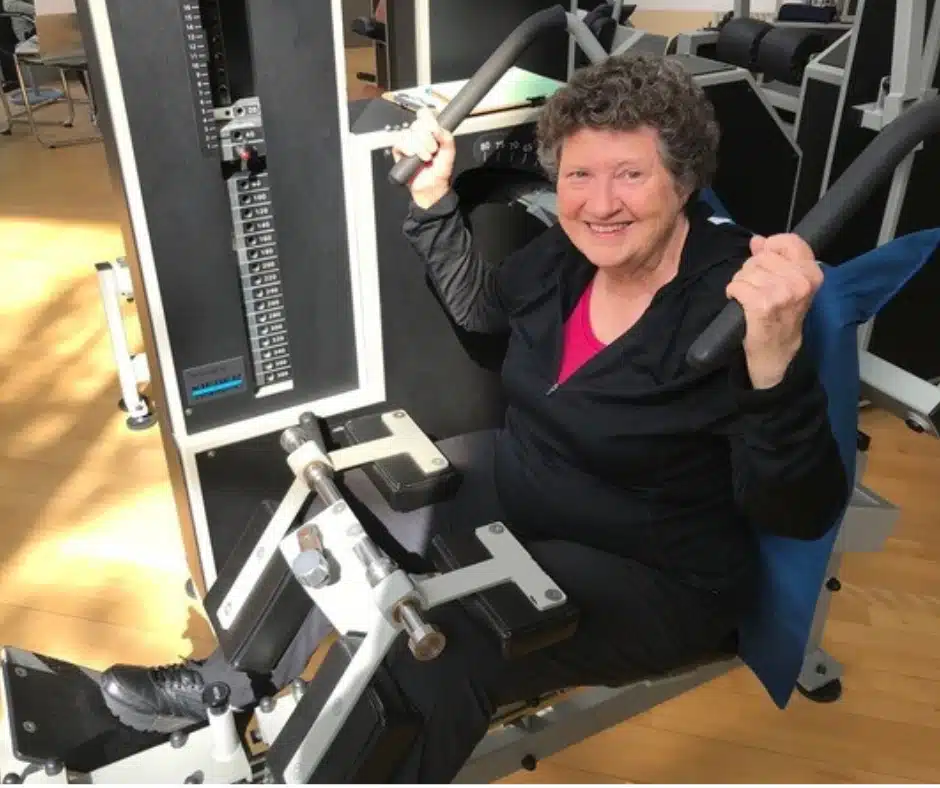
Written by Jenny Sharwood OAM, Victorian Hearing client.
First, it helps to have an understanding of how our ears actually work, as then we can have some idea of what can go wrong. Try the following link for a video that clearly explains the structure of our ears and how they work.
There is a variety of problems that can occur, that can impact our hearing. These include:
• structural defects – for example, a very narrow ear canal
• ear infections – for example, from swimming in contaminated water
• calcification of the ossicles or other damage to them
• cholesteatomas – a very serious, potentially deadly ear disease
• tumours on the auditory nerve – for example, an acoustic neuroma
• long-term exposure to loud noise
• trauma to the head
The following links provide very useful information.
https://www.schn.health.nsw.gov.au/ear-infections-and-glue-ear-
https://www.enthealth.org/conditions/cholesteatoma/
https://www.mayoclinic.org/diseases-conditions/acoustic-neuroma/symptoms-causes/syc-20356127
https://www.nidcd.nih.gov/health/noise-induced-hearing-loss
My ear issues started with a serious streptococcus infection when I was just four. Doctors believe that this infection probably set off my cholesteatoma. Throughout my schooling I had to cope with its very unpleasant consequences. (See the article on this disease.) To this day, the only treatment is surgery, but this was delayed by my ear specialist when I was young as she knew that even in my later primary years I passionately wanted to be a teacher. The surgical techniques used then would have destroyed so much healthy bone as well as the diseased bone around my middle ear. Those days the Education Department conducted very strict investigations of applicants’ hearing and would not have accepted me as a teacher with this loss.
I finally had the surgery straight after our Form 5 exams. My ear canal was also widened to reduce the chance of the disease recurring. There was a problem this. Proud flesh grew along the cut. Throughout Term 1 of Form 6 I had to keep going back to the city rooms of my surgeon to have the proud flesh burnt away with chemicals. My ear would throb for hours afterwards. This of course made that first term very difficult. It was little wonder then that I was so run down I became ill with scarlet fever over the first term holidays. But I was determined to get through Matric despite that. And it seemed the surgery had worked.
It was hard, however, to be told by my surgeon that I must never swim for the rest of my life, as the water could start up the disease again. This also meant I could not have a spa, or have my hair washed at a hairdresser. He also said that the lining of my facial nerves had been destroyed by the disease, so it was imperative I obeyed his instructions or I would end up with a paralysed face. But at least I was alive. No point in feeling sorry for myself or asking “Why me?”! I decided then and there to just make the most of what I could do and live a worthy, meaningful life.
In most cases of this disease, the surgery is the end of the trouble. Unfortunately, I have been one of those very rare cases in which the disease kept recurring, despite strictly obeying the restrictions. The next time it started was when I was expecting my second child, who was born just two days after I turned 27. As a result of the chronic respiratory tract infection that plagued me throughout the pregnancy, a ‘glue’ filled both of my middle ears for virtually the whole pregnancy, making me totally deaf. (The ossicles could not move.) My surgeon tried twice to remove the ‘glue’ via needles that he pushed through my eardrums, but this did not work. (After that experience, I vowed never to get my ears pierced!)
Being totally deaf for nearly nine months was an exceptionally isolating, worrying experience. It was like being locked in a glass cage. I was worried for the safety and well-being of my little daughter, and I was worried about whether my hearing would ever come back. Could I ever teach again? Strangers treated me as though I was intellectually disabled; some young shop assistants mocked me. Family and friends avoided me, as I could only communicate through written notes. I missed the sounds of music, birds and human voices.
I well understood Helen Keller when she said deafness is a worse disability than blindness. From the internet: “She said it causes deeper social isolation. Her core argument was: “Blindness separates people from things; deafness separates people from people”. She believed losing the ability to hear voices causes isolation from human connection, intellectual companionship, and communication.”
A few days after my son was born, I thought to myself: Oh, someone is sweeping. And then I jumped for joy. I could hear something! No-one ever rejoiced at the sound of a broom like I did that day! It was akin to the joy I felt when I had my cataracts done in 2016 and discovered that objects had sharp edges and rich textures and so many bright colours. (I had thought the air had become very polluted – until my bandages came off.)
But the hearing only ever came back in my right ear. In my left ear the cholesteatoma had thrived in the moist conditions provided by the ‘glue’ and destroyed the three ossicles in my middle ear and more bone. So I had to have another operation. The surgeon grafted in a set of plastic ossicles and flesh from my scalp over the bone to try to protect the bone from further erosion. Unfortunately, a few weeks later, the graft was rejected and I had to have an even longer operation to repair all that. This time I was very cheeky. After all, laughter helps us through many challenges. As I was wheeled to the theatre, I mumbled to my surgeon as he walked beside me: “We have to stop meeting like this!” … He was a very old-fashioned, formal gentleman. I don’t think he was amused.
It was then accepted I would be totally and permanently deaf in that ear. Being totally deaf in one ear has its unique challenges. I cannot tell what direction any sounds come from. This means I have to be extra alert to my surroundings all the time, and it is very difficult in a social setting. It made teaching exceptionally challenging. I had to concentrate very hard watching all the students’ mouths to work out who was talking. I would come home from school exhausted every night. But even today I watch people’s mouths to get an extra clue as to who is talking and what they are saying.
However, 1972 was not the end of my encounter with this disease. From 1972 onwards my ear was checked every few months for signs of the disease. I had two nose surgeries and intense allergy testing and treatments to try to keep the ear dry. Then, for no apparent reason, the disease started up again in 1997, and in 1998 I had my fourth operation to try to stop it. The new ENT surgeon I had this time was also a neurotologist. He placed electrodes across my face to monitor what he was doing because the risk of it being paralysed from the surgery was high. He had to stop the moment the alarms sounded.
I was astonished when he told me before the surgery that he was going to graft fat cells from my stomach into my ear to try to stop the disease. Imagine going around with some of your stomach in your ear! But then I thought: Maybe I will get a new svelte figure out of this! So when I woke up after the surgery, the first thing I did was pat my stomach. It didn’t feel any different. How disappointing! Then I felt my face. It felt normal and I could talk. What a relief!
My surgeon told me he decided to remove my ear drum instead because the alarms went off and he had to stop removing the cholesteatoma. As a result, I have to be even more vigilant about preventing water getting into that ear. Cold air and wind can make me really dizzy. And every six months I have to see an ENT surgeon to have dead skin cells cut out and to have the ear checked for the disease.
With all of this, and significantly reduced hearing in my ‘good’ ear (long story), for a few years I have had hearing aids to help. The one attached to my diseased ear can only act as transmitter to the other ear. The photograph below shows my current pair.
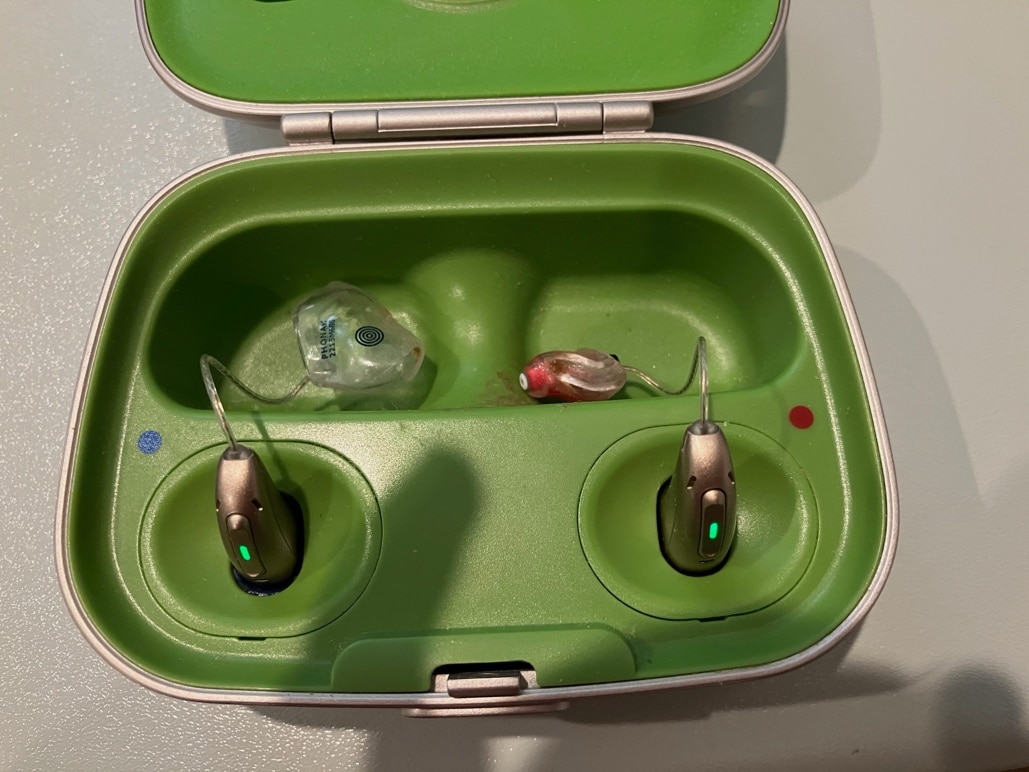
My rechargeable Phonak hearing aids, on charge. No tiny button batteries that have to be replaced frequently, which is very difficult if you have arthritis in your hands.
If your hearing is down, and especially if it has gone down significantly over just a few months, please consider making an appointment with an ENT specialist to check that there is nothing untoward happening in either of your ears. A CT scan and/or an MRI scan will detect if there is any cause for concern. And an ENT specialist can safely remove any wax that has hardened near your ear drum. (Don’t let a GP touch it!)
Next, please be very careful about who you choose to supply your hearing aids. You need a highly qualified, ethical audiologist to test your range of hearing in each ear. This is less likely with providers that spend a huge amount advertising their services to you on TV. An ENT specialist can give you a good guide. I have found Victorian Hearing to be an excellent provider. They cater well for pensioners too.
The hearing aids I use have other important features that you should consider when choosing yours.
1. The ear inserts were individually designed to exactly fit in the contours of my ear canals. The one on the left for my deaf ear with its wider canal was designed to have a ‘hole’ in it so air can circulate into the ear. Impressions were made using a putty-like material and the inserts then moulded from that. With well-fitting inserts, all the sound transmitted by the mini-computer that sits over your ear is funnelled into the ear. I have heard many complaints from people whose hearing aids were attached to tiny ear inserts, which simply fell out as they walked about and were lost.
2. They are programmed to boost the frequencies I have most difficulty in hearing. Just boosting loudness is not enough. Sounds would otherwise be distorted due to missing frequencies. The programming is checked and modified if necessary at each check-up.
3. The aids are connected to my phone via bluetooth. So I can hear the sound of my phone directly in my working ear. This connection can be used to control the sound via an App on the phone, if you wish.
We are so lucky to live at a time such technologies are available! I think of poor Beethoven trying desperately to hear through his ‘trumpets’.
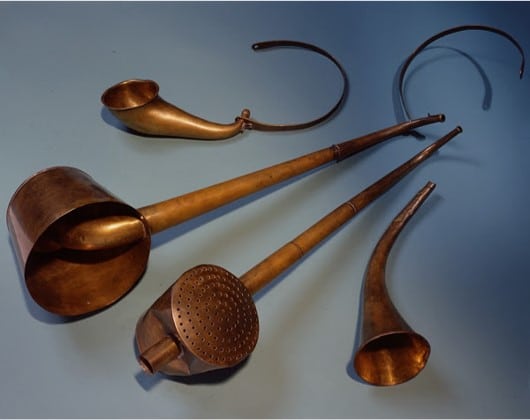
Beethoven’s ‘trumpets’
The other aspect to note is that rechargeable hearing aids operate on very tiny lithium ion batteries. So I only charge mine during the day and turn off the charger as soon as they are fully charged.
On another note, if you have suffered hearing loss from working in a noisy industry, you may be eligible for help and compensation. Please visit: https://industrialhearingservices.com
Book an Appointment at Victorian Hearing today and experience hearing technology tailored to you. Call (03) 9558 8842 or book online.